Rigging the Reserve Harness

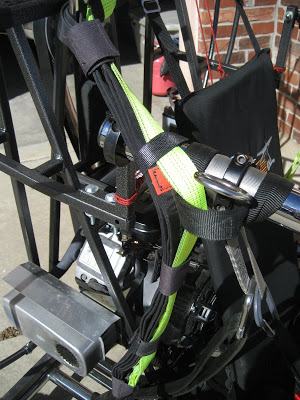
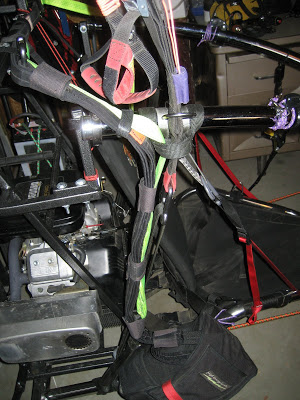
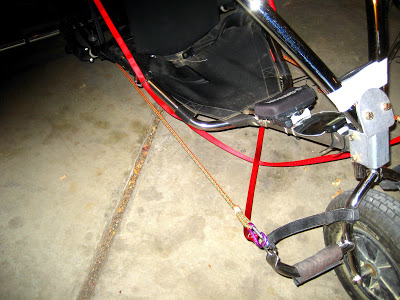
After much fussing and fretting this is the way I have rigged the Reserve Harness


The bridal is on a seperate attachment aft of where the riser’s straps attach to the buggy. They run through the saftey straps below the “hang point loops” and on top and outside of anything that could foul during deployment. I selected the right side because I fly with the throttle in the left hand. It will not help with any torque issues but I don’t think torque is to much of a problem with the thumper 4 stroke.

Kiting the Sting

The winds have been blowing steady for the last two weeks.
Too soon to put the boat in and to windy to fly.
So for the last couple of days I’ve been taking Monte’s wing out for a little high wind kiting. It comes up good but I’m having a hard time finding the right brake input. Either it wants to overfly and tuck or I’m using too much and the trailing edge puckers and the wing falls back. I’m not sure if it was a combination of trim and wind speed or just the nature of the wing. I think the lines are strung different because it’s a tandem wing.

Chad’s High Altitude Test Flight

Way to go Chad
12,000 MSL

While I was getting my ass kicked at Vance Brand Chad was setting a new record for the 4 stroke Trike Buggy

Here is his report…
Re: 12000′ 4stroker climb out
Posted by: “trikebuggydelta” http://us.mc01g.mail.yahoo.com/mc/compose?to=chad@TrikeBuggy.com&Subject=trikebuggydelta
Mon Mar 2, 2009 10:01 am (PST)
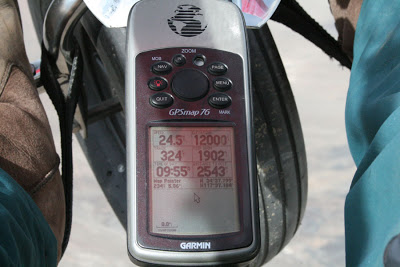
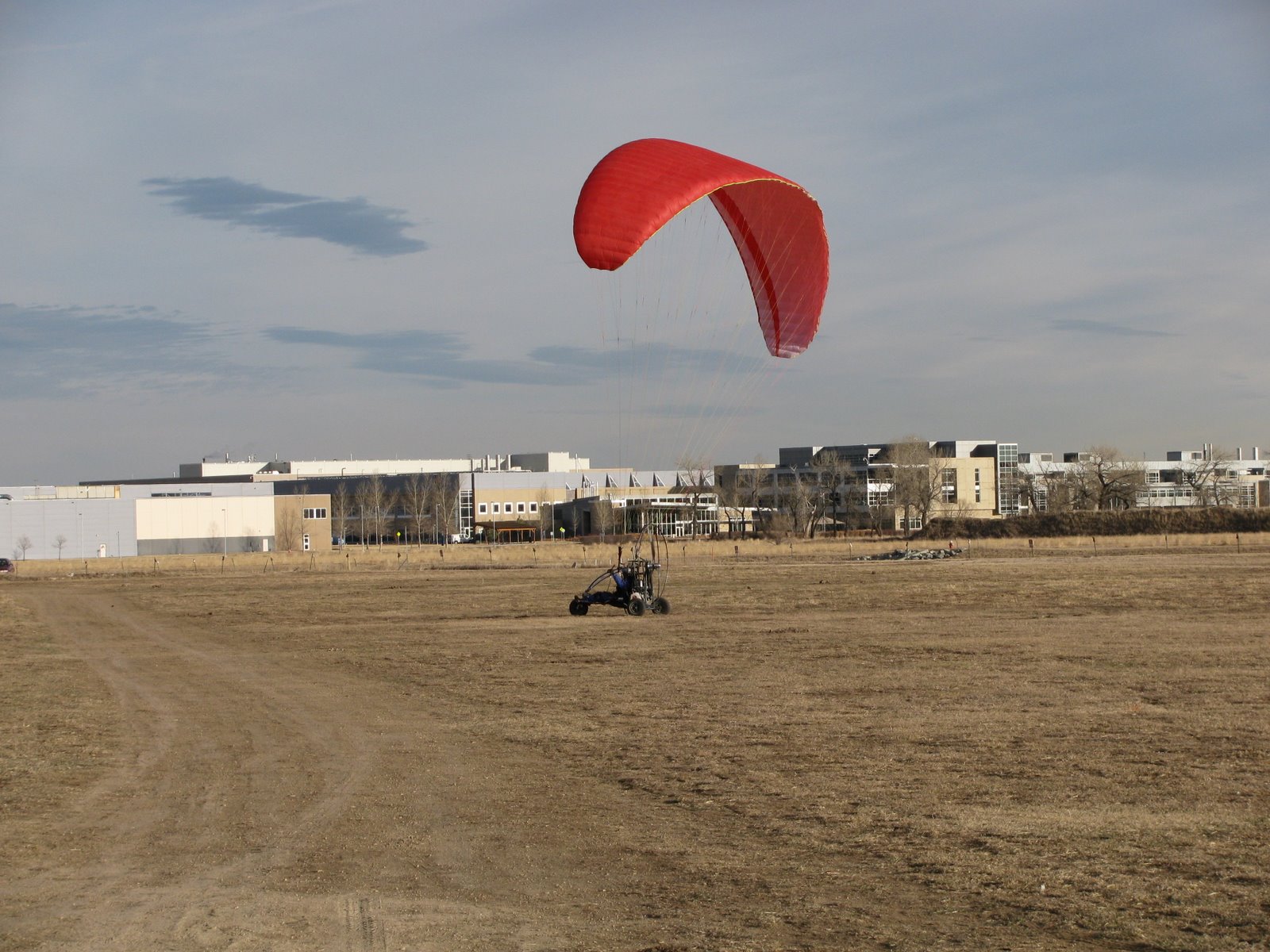
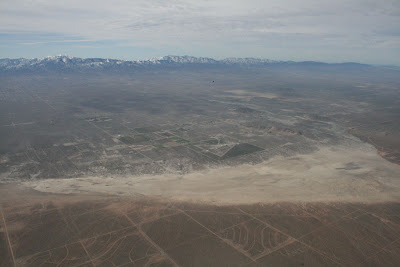
Thumper High Altitude TestsI went out to El Mirage and the Flying “J” Ranch this last weekend tofly the Thumper. I wanted to launch and land the machine, maybe ahundred times, and really get a feel for it. I wanted to do some highaltitude tests, to see how high it would go and what the climb rateswould be at different altitudes. I got there Friday afternoon, and pulled the Thumper out of my shedand gave the key a try. BrBrBRrBrBr, it sounded like a jackhammer as Irealized that I should have removed the positive battery lead before Ileft last time. I pulled my Toyota over near the Thumper and gave herthe breath of life. I let the Thumper run for close to an hour,letting her charge the battery up so I had a bit of reserve. The greatthing about the Briggs & Stratton motor is that this thing just runs!You simply start it, and it just loves to run. I changed the throttlea few times to 2000 and 3000 RPM, and sometimes I would run it rightup to full (at the pitch I had the IvoProp at, it topped out at around3400 RPM – should have been around 3800), then let her rest at around1200 idling. Finally, started setting up for a flight. Wrong! Once I got in theair, I could see why the Quicksilver Ultralight pilot looked so amused- it was punchy! On the ground, it was maybe 0-4 mph, seemingly niceconditions, but once in the air it was a different story. I did a fewgo-arounds and decided that it was a bit much for me and landeduneventfully. I spent the rest of the afternoon installing the FootSteering, a Reserve Parachute, more velcro for the instruments,getting some more gas and generally tightening everything andpreparing for the evening flight. At just before sunset, I launched again, and enjoyed maybe 30 touch &go’s before it got so dark I was squinting to see. I was flying theDudek Synthesis 34 glider, and it worked beautifully with all thatThumper weight (220lbs) dangling from the lines. I trimmed this reflexglider full slow for this flight, and it inflated perfectly everytime(5 inflations) with the A-Assists and was still fast in the air.Looking at the risers, I saw that full slow is actually a bit slowerthan trim speed, so I set the trimmers at 0 (there’s actually numberson the trimmer) to put the glider at true neutral for the morning flight.Jerry Frost and Pierre Beney arrived this evening, and we spent a goodbit of time ‘Hangar Flying’ around the campfire, watching the moon setalong with that planet, really spectacular!The next morning, I warmed the Thumper up for flight. With the twistof the key, she stirred to life and seemed to be content. I let herrun for a good half hour at idle, something I would never do to any ofmy two-strokes (they would coke-up and choke) while I prepared forgoing high. I used a Flytec Vario for climb rate, a Garmin GPSmap 76for better altitude, and my iPhone with the V-Cockpit app running, avery cool airplane instrument application that uses the internal GPSfor navigation. Only problem was the iPhone was so dim that is didn’tcome out in the pictures. You can see one shot of it in the photogallery on the Altitude screen, just one of the many functions thisapp has. Check out the main screen by clicking the small icon here toyour right. It’s a really cool Application, and I had fun playing withit as I flew. There’s even graphs of the entire flight showingaltutude, speed, climb rate, heading, but no way to save them! At about 8:30, I launched from the Flying “J” Ranch at approximately2850 feet and velcro strapped the throttle at full and sat back andrelaxed, took pictures, video, and wrote down info at each 1000 feetof altitude. On this first flight, I did not write the time down, butyou can see the time on the pictures of the GPS, so it tookapproximately one hour to climb to 8000 feet and 1:25 to climb to12,000 feet. I was still climbing at 12000 feet, but very slowly, andI was cold – I didn’t wear enough layers to keep out the chill. Plus,I had not pitched the prop for maximum efficiency, at ground level itwas only 3400, and it got slower as I climbed. The motor ran beautifully the whole time, not even a hiccup. I amamazed by the four-stroker’ s incredible reliability. I could get usedto this! Trouble is, when I fly a two-stroke again, I’ll be wonderingwhen it will happen…. the inevitable motor-out. This motor is madeto run, and run, and RUN! I let it idle for a few minutes after Ireached 12K, then shut it down for the long glide back down. I reallyenjoyed the views from up high, there was snow on the nearby peaksnear San Bernadino, and I could see all the way to Tehachapi to thenorth and into the LA basin through the El Cajon Pass.

265 266 Vance Brand Airport

Biggest gathering of Denver area Pilots in a couple of years.
Paul Meyer Paul Crazy Ivan Marek Dan Robert Kitilla His son Mark Bennet Some spectators and maybe one or two who’s names I cannot recall.
Plus that’s not all…Wait there is MORE. Three flights of Scoop Divers.

I should have expected some weirdness when the temp dropped from 57 in Denver to 45 at Vance Brand. there were light winds from the North at 3:00. The first flight was ok …a little bumpy but ok.

I had to taxi for longer than usual to get off and the climb out seemed slow. First thing I noticed was that the left Brake line was bound in the risers. I was able to free it without problem since

nothing was crossed …just friction locked.

Max climb was 170 ft / min. I noticed that several of the guys were setting down so I did too. The landing was a bit hard. I killed the motor to0 soon or late and swung under the wing. No damage just didn’t look good. If I’m going to come in dead stick I should decide sooner than 10 feet.
Second Flight was a real pucker. After I set-up, the wind shifted. Rather than re-set I waited and launched when the cycle came around to me. The wing came up much better without the “A” Assists. This time I climbed at 180ft/min When I got to 1200 feet it started to get bumpy and I was climbing at 300ft/min! Even at idle I was still climbing over 100ft/min.
What a ride! The wing was alternately surging and falling back and a couple of times I found myself in a hard bank and starting to get weightless. It was one of those times that you can feel the wind shifting by the way it feels on your face. I was no longer flying in a stable mass of air..It was a good thing that I didn’t have the full height of pad behind me because the extra visibility came in handy to be able to watch the wing. There were several forward surges and while I never saw the trailing edge …it was hairy enough. I think that I was perhaps a little timid on the brakes because I couldn’t feel the wing and the forces working on it. I was contemplating Big Ears when I finally started to descend. I think I was in the worst of it for 3 or 4 minutes and I made the mistake of turning back into it again before I figured out that it was the west end of the box that was being pulled into the clouds…..NO FUN!
The good news is that the landing was better, I left the motor running and came in at idle.
I’ve found a better position to hold the throttle but it is still hard get fine control of the RPM’s. I look forward to using an FB throttle again!
The next time I see lenticular clouds I’m going to think twice. The didn’t seem to be moving but were hanging there sucking up the warmth.
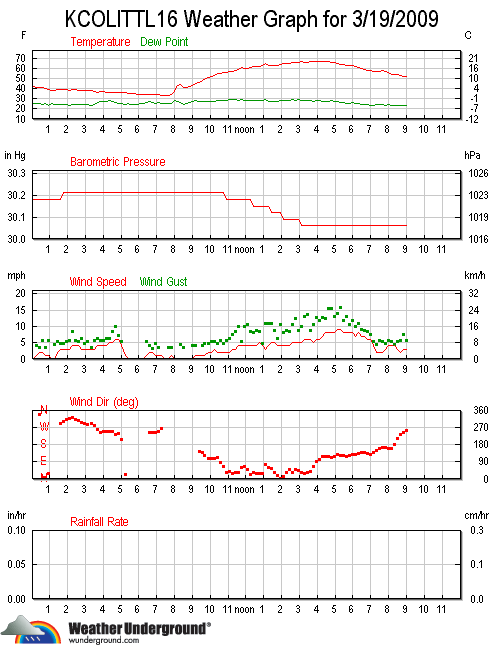
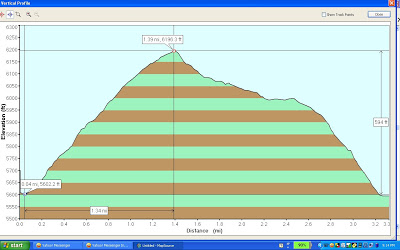
Looking at the profile I was just getting into the nasty stuff when I decided to land on the first flight. It’s probably why I took one look at everybody landing and decided to do the same. The guys that stayed below 300 feet had very little turbulence but there were high winds aloft and the clouds were sucking the warm air from below…Big time…Maybe it was a clue when it got warm about 4:20. (from 45 to 50 plus in about 10 minutes. Be Aware when the temp is fluctuating…And watch out when there are lenticular clouds and signs of high winds aloft !
Later on the ground we stood around and it was so obvious to all of us, that it was ugly at altitude.

Today’s lessons…
1. Watch out when the temp is bouncing around especially if there are lenticular clouds.
2. To Hell with A Assists!
3. Ease the throttle cable
4. Don’t kill the motor at low altitude just to have the prop stopped when you land… come in under power and grease it.

Dialing in the Thumper

This evening I worked on getting to know the machine and making it more pilot friendly.

First I set up the foot steering with all new webbing.

Then I remounted the tach at a better angle so that I’ll be better able to read it in flight.

Then I lowered the back pad so that I can look over my shoulder. It might be too noisy but it feels good and the additional visibility is great!

Last I mounted another mirror in the crook where the bullet bars come together so that I’ll be able to see the wing during the first seconds of inflation. I’m hoping this will be a temporary training device and I won’t need it.

No Fly Day…

65 degrees

light and variable turning strong from west

Got to the field by 3. Driving North on C 470 I saw moderately strong air coming from the East by North East. At the Hampden & Simms is was manageable but I soon noticed that it was swinging on a huge ack from south to East To North and back again.

I was a little skittish especially since I had guess that the prevailing wind would be from the East.

There were a couple of spectators watching when I set up to launch and reported that the wind shifted from the west just before I started the motor. The wing came up crooked and collapsed quickly. It’s probably a good thing I decided to about. It continued to build and when i unhooked and kited the wing… it was strong and twitchy. Both tips collapsed in a sort of complicated pattern. It looked like it was going to continue building and I wanted no part of a spring air that was being filtered by the Rockies.

Mechanical I’m not sure that using shock cord for the A Assists is the best answer. I suspect that I didn’t get the tension equal and it was part of the reason for the bad inflation. Next time hook em up but still get on the A’s with your hands!

263 264 First Colorado Thumper Vance Brand

Temp 45 to 50 f
Climb 200ft/minute
Decent 200/minute
3550 max RPM
Powerplay Sting 250


It was good to get this one past. I met Robert K and Marek M out at Vance Brand Airport.
We launched at 3pm in light winds from the North East. First attempt went bad when the A Assists were not putting enough pressure on the wing causing it to hang back. On the other launches I got on the assists manually and it came up just fine.
(change the endless clamps so the tails point into the cage instead of out where a line can get into them)
Another thing is to be sure the Starter/Tach bar is on the correct side when attaching the risers.

I accidentally killed the motor at 230 feet, when I noticed the starter bar was being pulled by the riser strap. I had time to try one restart but failed and came in dead stick. Smooth as a baby’s butt!

Second flight was great…no problems 200ft/min climb and about the same decent.

Monte’s Powerplay Sting was rock solid and the brake pressure was about what I was used to with the old rig.

Marek and I kited Brian’s wing…it is 2003… very light construction and absolutely not the right wing for this application….nuff said

I need to find a better way to hold the Throttle or get a different one. The ol fresh Breeze lever would probably be just fine.
The next time I’m going to try using light bungee cord for the A Assist to see if I can get some more pull on the A’s and not be pulled forward of the rest of the risers during flight.
One thing that has to be mentioned. At one point I hit this spot on the power band where the noise and vibration was reduced dramatically. It was eerie, for a second I thought the motor died. I think it was a combination of things including including belt slap, prop flutter, and who knows what else. It’s too bad that it was at 2250 RPM which won’t sustain level flight. But I’ll bet it would at sea level with a 62 inch prop!

Cage Netting

Critics

During the Salton Sea and at the Flying Circus there were plenty of opportunities to stand around the Thumper Bullet and critique the design.Whenever the topic of cage netting came up I was surprised when the first thing said was, “Your going to lose thrust!” or “Its a trike you don’t need it.” These comments came from respected pilots.So…How much thrust can it lose?Especially when your not as concerned about keeping hands out of the prop as that rare time when the wing does the unexpected and a line falls near the prop.The thumper cage is new and twice pilots hooked a line at the Salton Sea. PLUS…a four stroke doesn’t shut down as fast as a two stroke so there are going to be a couple of revolutions after you hit the kill switch.

You don’t need much…

I’m not talking about some of the “hammock netting” I saw stretched over the cages of brand new quads.I’ve posted pictures of a minimal net meant to protect from Line Strike. Zip ties make it easy to get the lines tight as a tennis racket and 300 pound deep sea braid is thin and easy to tie.

Redundant Zip Ties

( one under tension)

Tweaking the Thumper

A assist with rope ratchet

— On Wed, 2/18/09, jo3jo2003 wrote:

Terry Chad,
I’ve been dialing in the “Colorado Bullet Thumper 4stroke”.Epoxy Gel and a new longer split fuel hose anchored the motor end of the throttle cable. It was moving around and preventing a true idle.The engine is max at 3800RPMidle at 1800RPMI can probably Pitch the IVOs more…BUT?Chad…how far can you pitch the IVO blades and how do you know when to stop?Can you “over warp” them and damage the system?Maybe I should learn how to measure the pitch just for the “pure research” as you put it Terry.I was glad to read about “belt Flop” on the slack side of the drive system. I’ve noticed some flop and wanted to ask how to determine correct belt tension. If I understood you right what I’m seeing is about normal.Last…Terry ….what do you think? The local Briggs & Stratton guys say I can install the high altitude carb kit in 15 minutes or less. I’m going to be launching from 8200+ MSL a few times this summer and the rest of the time will be at 5300 MSL. I’m thinking that it might be a good if I used Hi Alt jets here in Denver and the mountains and switched to the stock jets for the coastal stuff. These guys are willing to show me how to install and adjust them for the price of the labor Don’t worry….Before I start changing anything I’ll see how it does at the home field. But I wanted to run it by you.It’s just too damn cold and the best I can do is tweak the machine.
JoeO

Hi Joe, I was thinking of you today.

I think 3800rpm is fine.

Belt ‘flop’ on the slack side is normal, but I find it’s best not to watch it;); BTW, I have never lost a belt or even had the belt jump a groove. Belt tension is not something you need to worry too much about..tension it about like you would your underhood car belt. If the belt ‘flops too much to suit you, tighten it a little more, you won’t hurt anything (however it’s probably just fine right where it’s set now)

I don’t know about hi elevation carb kit, but I am curious about it..I wonder what the kit includes? Smaller jets? Different air filter?
One thing that might help is to remove all the filters from the intake shell. Please let me know what you learn about the kit.

It’s cold here too; I delivered a new unit to Indianapolis on Sunday and I demo’d it for the buyer; a 5 minute flight was plenty for me.

Terry

Flying Circus Wrap Up

The drive home was good. I had a massive cold front following off my left shoulder all the way from Albuquerque. At one point the shadow from the leading edge was playing tag with the truck and we were doing 80 mph! Fortunately it stalled at Raton and I never had to deal with icy roads.
The Arizona Flying Circus was great….frustrating but great. Lots of vendors including ParaToys who would never have been welcome or inclined to attend under Bob’s ownership. Nirvana and Paradrenaline were there and their “factory Pilots” put on a great demonstration of flying in ratty air and high winds.
I spent most of my time dealing with equipment issues. The first morning was the most heart breaking because I walked off the field when the battery died. It was two days later that I realized that all I had to do was use the pull start. Doh !
The new cage arrived on Friday afternoon and I spent the afternoon working with Bob Pelloquin to get it assembled and mounted on the frame. As fate would have it there was a crowd of luminaries standing around when it was time to fire it up. Sure Nuff there was a prop strike and one of the tips was damaged. That evening after dinner with Jim King and a couple of other pilots I sat in the hotel room and replaced the blade with one that Johnny Fetz had repaired while at the Salton Sea.
The IVO Prop is an amazing design that enables you to adjust the pitch of all three blades simultaneously by turning a bolt in the hub. Counterclockwise to increase pitch and clockwise to reduce pitch. I had to take it apart and assemble it twice before I got it right but that seems par for the course for me at this fly-in.
The next morning I attempted a launch but the wind picked up and I didn’t react fast enough when the wing pulled me backwards. The buggy rolled to the left and I was forced to kill the engine and abort. Jeff Goin was filming so he was able to brief me on what the wing did. I’m going to have to increase the tension on the steering bungees so that it rolls straight. While I was out there a pilot asked me to start the machine so that he could hear it. Right away it was obvious that the prop was badly out of balance.
The rest of the day I spent working on the machine. Bob and I did some creative bending to increase the clearance and Kent helped me out with shortening the blades by 2 inches. I was wary of making the cut but Kent dug in and they are looking good and well balanced now.
Saturday afternoon was the Bowling Ball Cannon and later the Banquet. It’s all Good.