First, you really need to have access to very smooth laminar winds. It’s easy here at the beach. Initially, I tell people to start learning foot drags in smooth laminar winds. This develops the fine skills to be able to maintain level flight over long stretches of ground. If you can find wind conditions of 10 mph with a beach, this is some of the most perfect conditions you can have. After you have mastered flying your unit and being able to drag your feet for a hundred yards or more (Here in Houston we can drag them for a mile or more on the beach without lifting our feet), then you are ready for the next step. Myself, just to be safe, when I say footdrag, I mean flatfooted with the sole of your shoe dragging the ground. That way, should you get just a bit too low, you can run it out and with a 10 mph wind in your face, it isn’t that hard. After you are doing well at the 10 mph winds, gradually start doing foot drags in less and less winds until you can do a foot drag in 0 mph winds. After you have mastered foot drags in 0 mph winds, you are ready to move now to powered on landings. Landing with engine running in a 10 mph wind should really be a non-issue for pilots that have developed good landing skills. If you don’t feel comfortable just doing a regular motor (idling) on landing in 10 mph winds, then you are better off not even considering a powered on landing. Now with powered on landing, I would start with the 10 mph wind condition day. As you come in doing literally another foot drag, while doing the foot drag, begin adding more and more brake/flare. As you are adding more brake/flare, to maintain flying level, you will need to add a bit more power. As you apply more brake/flare, you will need to continue adding more power. At a point while doing that foot drag, you will have basically reached a point you have added sufficient brake that your next step and input on the brake puts you at a speed of “0” and you have landed. After you have this going well, then start working in conditions with lighter and lighter winds doing foot drag approaches. As an example about 3 weeks ago, I landed at the beach in about 1-2 mph winds. It was going to be a bit fast. I approached into the wind, started my foot drag, and started flaring but adding power. After 75′ of dragging my feet, I had then slowed things down to the point I walked off very nicely in 2 or 3 steps the remaining speed. Another point to make here is that while doing your foot drags and powered on landing approaches, drag with one foot, but keep the other foot out in front of you ready to take a step. Don’t drag two feet as it puts you in a poorer position to recover if you suddenly need to run something out. Myself, I think being able to fly inches off the ground or dragging feet for extended periods of distance is a skill that everyone should try and master. What it does is develop the hand/eye/wing/throttle coordination to respond tithe most minor of air disturbances and leads to a pilot that can actively fly. There are a lot of times I fly with other pilots and they complain about it being bumpy and it isn’t to me as they aren’t actively flying their wing. The finer your control of the wing, the more you can dampen out the bumps and oscillations and the more enjoyable the flight. That’s my 2 cents. Beery
Category: Technique
#352 & #353 Chatfield …Power on Landings
God made Days off for days like today!
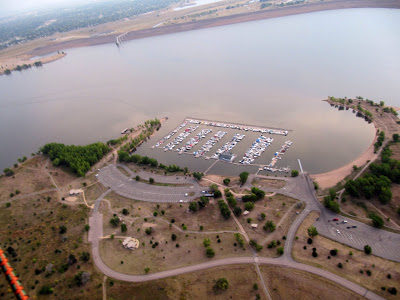
The season is changing and it’s happening all too fast. Now days, when I get to the field at 6:00am, it’s O’Dark Thirty. Plenty of time to finish that Rock Star and let the caffeine get into the blood stream. It had been partly clouding all night and this morning was hazy and 55 degrees
The wind was SSW variable 4 to 7 which meant I had a slight uphill grade and rotor from the “Club House”. The wing came up fast and the buggy had stopped rolling after the first two feet, I was able to add a little “foot power”, but the wing stalled and fell to the left, by now, I was starting to roll, so I added right brake and watched the wing swing to the right until the tip was about 6 feet above the ground. Now some left brake and this time it centered and was rock solid over head. Small wing Heavy trike… The Eden III is easy to muscle around because it’s smaller, lighter material and more responsive than the Power Play. I don’t think this would have tipped the Trike Buggy Basic but I’m sure that I would have felt the trike start to lift on one side. Because of the extended wheelbase and low and heavy CG, the Thumper is incredibly forgiving. When the wing was about 40 percent loaded the “side pull “was just discernible.
The wind was SSW variable 4 to 7 which meant I had a slight uphill grade and rotor from the “Club House”. The wing came up fast and the buggy had stopped rolling after the first two feet, I was able to add a little “foot power”, but the wing stalled and fell to the left, by now, I was starting to roll, so I added right brake and watched the wing swing to the right until the tip was about 6 feet above the ground. Now some left brake and this time it centered and was rock solid over head. Small wing Heavy trike… The Eden III is easy to muscle around because it’s smaller, lighter material and more responsive than the Power Play. I don’t think this would have tipped the Trike Buggy Basic but I’m sure that I would have felt the trike start to lift on one side. Because of the extended wheelbase and low and heavy CG, the Thumper is incredibly forgiving. When the wing was about 40 percent loaded the “side pull “was just discernible.
When the wing is oscillating like that it’s a good time to be looking up at the glider. 🙂 The mirror is great for some pilots, but it tends to take up too much of my attention and I lose the big picture. The climb out was slow, which was made worse because the surface was sloping upward. Once up, it was mostly smooth air. The winds were flowing in a circle, clockwise around the area. I could fly downwind along the western edge of the park and still be downwind on the east side of the park coming home. The neat thing was that the area around the Balloon Port was calm, because it is inside the circle. I watched two balloons go up and hang right over the Port, they didn’t move 20 feet except vertically the whole time they were in the air.
I took some shots of the Marina, landed power on and practiced the low and slow. Then took a brake and did it again. The overcast had damped any thermal activity…I could have flown for two more hours it was that good!
Chad…Please bring some different length hang straps and help me dial in these wings for the Thumper Bullet.
1. Measure the current straps and Riser position in relationship to the hang point rings
Density of Altitude
A surprisingly accurate rule of thumb (usually any error will be less than200-300 feet) for determining the density altitude is easy to remember. For each10-degrees Fahrenheit above standard temperature at any particular elevation,add 600 feet to the field elevation. (And, conversely for each 10-degrees Fbelow standard temperature, subtract 600 feet from the field elevation.)Standard temperature at sea level is 59-degrees Fahrenheit. For elevations abovesea level, subtract 3.5 degrees per thousand feet of elevation from the sealevel temperature of 59 degrees.For example, at Jackson, Wyoming the elevation is 6,444. Multiply 6.444 times3.5 for 22.55. Subtract this from 59 (59-22.55) for 36.45. The standardtemperature at Jackson is 36.5 degrees. If the existing temperature is 80degrees, subtract (80-36.5 = 43.5). Divide this difference by 10 degrees (foreach 10-degrees F above standard), and multiply 4.35 times 600 (600 feet per 10degrees) which equals 2,610. Add 2,610 to the field elevation (6,444) for adensity altitude of 9,054. Under the existing conditions (of our example), theairplane will perform as it would on a standard day at 9,054 feet elevation
#329 & #330 Simms

Three Flight Day!
Light breeze from the NE…very unusual. The air was pretty good except directly south of the High School where it was bumpy. Might be the air is picking up something over all that concrete and brick. There was lots of lift everywhere I went. Over the Golf Course and Damn I encountered flat air but I never seemed to get any sink.
For awhile I practiced diving the glider by slowing down the wing with some brake and letting it surge ahead. It will be interesting to see how far I dropped on each mini dive. Next time I’ll try it a little lower so I can gauge the amount of drop by eye, from 1000 feet I could see the nose wheel drop and could feel the decent in my gut but the GPS just isn’t fast enough to read in real time. The dive doesn’t last long and if I power up I’ll swing ahead in a steep climb which I could turn into an even steeper dive by cutting power at the top. Next time…
The landings keep getting better, it was almost like the Eden during final flare, I was able to control the float longer than I ever have with this wing. It’s all about getting the brake line past the point of maximum pressure. It might be a leverage point where it feels easier but the pressure is the same, whatever it is…I feel it bump into “Float” and then it’s fine movements that control the sink and lift. Done right I should be able to do the “low and slow” for a long long way.Chad talks about bringing the hands all the way under the buggy but unless I want to collapse the wing I don’t think it’s helpful. The question is how much brake will stall the wing in normal flight with power and without. Tomorrow I’ll try it with the trimmers open.
307 Simms
Another Downwind Launch!
It was a 890 ft downwind run out through the weeds.
30 mph take off speed 2833 ft AGL…42 minutes flight time.
When I got to the field it was dead calm, so I set-up SSE on a gentle grade with 200 feet of short weeds. Sure nuff…by the time I had hooked up the buggy and put on my helmet the wind was coming from directly behind me at 4 mph. If I were going to reset I would have had to move more than 150 yards and the odds were that the wind would have shifted again. So…I cussed and decided to wait. After 5 minutes it looked like the pattern was set against me…. so I watched the wind sock and when it looked like it was slacking …I punched it. 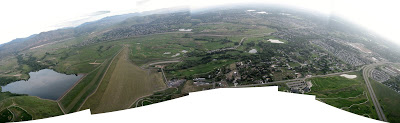
Off we went, like something out of a Disney Movie, a couple of times I hit a particularly big weed (more like a small bush) and felt the buggy slow down. It was very like the launch a week ago in Colorado Springs. I was moving fast and could feel it wanting to fly but the tall weeds were keeping me in the ground. I finally popped some brakes going 30 mph and the buggy came up. It’s lucky I didn’t damage my delicate IVO prop because I was plowing through some pretty thick stuff. It broke the ignition off the stem but it was only a spot weld on less than 1/4 inch rod and inherently weak. My fleece jacket was impregnated with hay seed, each one is going to have to be pulled out individually and I bet it’s going to take an hour.
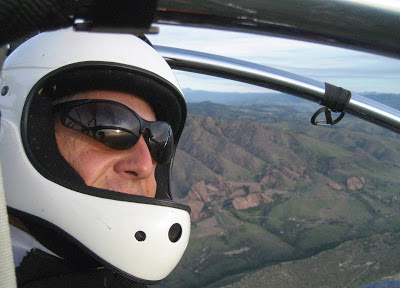
Very nice flight. I saw a Delta trike flying between the hogback and the foothills moving like a bat out of hell North to South. At first I thought it was two in a tight formation until I realized that the trailing craft was really his shadow on the mountainside. Worked on level flight and steeper spirals. I really pulled some brake on the final flare ans was surprised by how much resistance there was. I’m thinking that this wing can take allot more input than I’ve been giving it. I picked up a big twig during take off it was in the brake lines close to the wing. There was enough drag on the right side that I had to let out the right trim to fly straight.

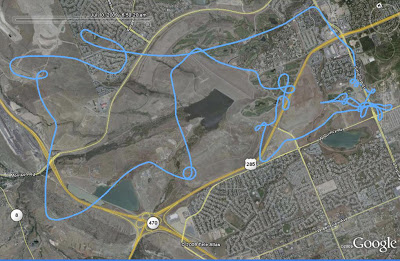
306 Simms
Nice ordinary flight, light breeze from the WSW.
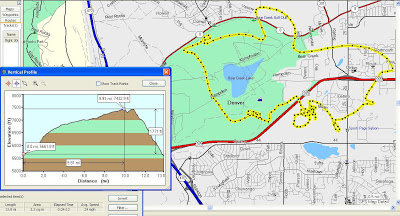
I launched from the only place I could find where the grass was short enough to get the buggy rolling. The run out was going to be 30 degrees off the wind but I figured it was worth a try. So…I layed out 10 degrees off and prepared to damp the right side during inflation. The wing came up crooked as expected, I added power and with moderate brake input got it stabilized almost immediately. Cross wind launch went surprising well. It’s all good!
Down wind of the damn over the golf course there was allot of sink I was just barely able to hold altitude at full throttle. I didn’t want to fly over the golfers at 100 feet so I flew west until I was up wind of the dam and there was the lift! After doing a few turns I headed to Red Rocks but cut north before leaving Bear Creek Park figuring that the west wind would be throwing some rotor by the cut in the Hogback.
I explored the far north area returned to the field and did lazy circles until I was low enough to set up for final.
The landing was 10 yards off the target at idle. Not good enough for competition but sure as hell PPG 2
When I got home Marek called and said that I was on News 4, Tracy recorded it and will burn me a copy. Very cool.
#295 Simms…Red Rocks
Most excellent day!


It was drizzling while I loaded the truck at 5:15am. There was a low cloud cover 0n the North and Eastern horizon and patches of virga over Lakewood. I checked out the Lucent site and was just about to unload when a puff came out of the south and spoiled the moment. One morning it’s going to be coming out of the east or north and I’m going to try this place out!
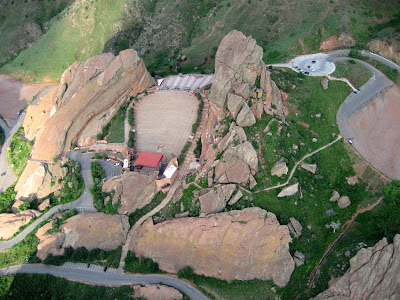
So…I headed off to Simms and repeated yesterdays trick of setting up in the short grass and running hell bent for leather into the taller grass. Today I learned another reason for wearing the flight suit…it would have kept the grass seed from embedding itself in my fleece top and pants 🙂
Today I didn’t have any GPS so I couldn’t tell what the climb rate was …but it felt just fine…I might be making a fuss over nothing but I think it would be a safer machine if I could levitate a little faster.
There was very little wind and the clouds had mostly moved to the East so I took the opportunity to fly over to Red Rocks Amptheather. It was a beautiful flight, clear and light in the west and cloudy and dark behind me. The sun had just started to peak thru as I was approaching the hogbacks …great light for photography…and lots of lift. After circling the theater and taking a few pictures I flew back toward the golf course and used the lift band at the dam to get a bounce.  Probably the best air I’ve experienced in a long long time. The descent took a good long while and I worked hard to position the buggy for a long final approach. Finally I was able to run 500 yards to the truck just a few feet up and touch down light as a feather exactly where I wanted. It was nice to get a little fine control I’m even getting a better feel for the throttle. If I have the room to maneuver this machine puts out plenty of power, it’s only where I’m working in tight quarters that I get puckered up.
Later I took the crew for a dinner sail. It’s all good

Flight #281 Falcon Colo.
Good Morning !
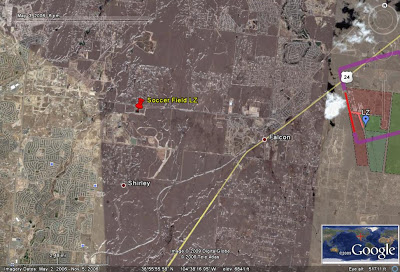
Light Winds 47 degrees Blue Skies
I left Denver at 5:30 and drove down to the Soccer LZ by Falcon on the North East side of Colorado Springs. John Black passed me with a big smile just before I arrived. It’s a pretty good LZ but there are a few challenges: tall power lines to the south and the road and lines to the north. The field is great with hard pack and astro turf. There is a cut in the fence to the left of the locked gate but it is a bear getting the Thumper over the berm. As luck would have it as soon as John Kevin and I finished lugging the Thumper, a lady came along and unlocked the gate for us. The winds were light from the South West. Kevin and John took off quickly and I blew my first attempt.
BUT… It was a good thing because I have finally discovered why I’ve been blowing so many launches. My A lines are getting caught on the bottom of the line guides. It is going to be easy to fix by using the guides or taping the bottom so that they will not catch the lines. I climbed to 1000 feet and watched John carve it up. Lots of open area for low and slow with a great view of Pikes Peak. I stayed up 35 to 40 minutes and landed when my hands started to get really cold. The wind had picked up some and was more from the South but the landing was smooth.
Great Air and a beautiful morning. Kevin landed and went up again to mark his 300th flight. John also launched for a quickie but it was a strange launch because one of his trimmers was out and the wing was giving him fits. I thought he was trying to do a cross wind take-off and it took a long time for him to get off the ground. He figured it out after running halfway down the soccer field and adjusted with more left brake.
Congratulations Kevin ! …
We talked about the Rocky Mountain Balloon Festival and he thought it was still on but after checking the web site I confirmed that it is definitely cancelled this year. The site says that they will return next year in partnership with another Festival Promoter…Big Words…I hope they can do it.
The ride home took an extra 30 minutes because VP Joe Biden was speaking to the Air Force Academy Graduation and they were stopping traffic until he passed.
Rolling Resistance & A Assists
It might be a good idea to add some pressure in the back tires to reduce rolling resistance during inflation and roll out. If that does not work …then try some wider tires. The downside of bigger tires is that the buggy will not fit into the bed and will have to travel with the back of the buggy riding on the lowered tailgate. It might not be a problem but I don’t think I’ll be able to handle rough terrine as well if the tailgate can bounce up. Maybe if I use the ramps I can dampen the tailgate.
Today I saw the benefit of the A assists. If I’d had them engaged I wouldn’t have blown a launch I could have grabbed the assists and added some forward pressure. I think I’ll hook em up next time and use them as a guide to the A’s.
#275 Simms
Same beautiful conditions as yesterday.

The recent rains have jump started the prairie grasses making it a much slower surface to launch from. It took 3 attempts this morning. the first two because the buggy bogged down after clearing the ramps. I think if I’d kept the A’s in hand I might have saved the second launch but the wing fell back and I just couldn’t get enough speed to get it back overhead.
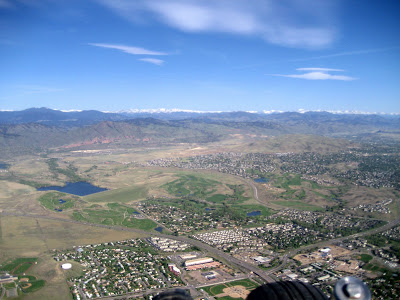
Then…on the 3rd attempt I didn’t clear the brake lines properly and the right hand line was looped up and over the b risers. It cleared itself quickly but there was a moment when I was considering an abort.

The RPMs have come down 150 to 3550-3600 and it’s decreasing the climb. I’ll back off the pitch a little bit and see if I cannot get it back up to 3750.
The Garmin 176-C is shutting down when shaken so I’ve removed the mount and will do everything with the Foretrex 102 from now on.
This morning the air was very calm until 6200 MSL where I ran into mixing air and some early thermal activity. It seemed to get worse the higher I went so I came back down to 500 AGL and enjoyed making turns over the patch as well as the High School and Prison.
I look forward to trying another wing…this powerplay likes to dance and I’m not so fond of the way the buggy is dancing under it.
Next flight I’m going to move the hangpoint loops 3/8 inch forward to increase the thrust vector and hopefully improve the climb.
All in All after the hassle of launching….It was a good flight. Only 25 more to 300!
 Powered Paragliding. A most Personal form of Flight
You must be logged in to post a comment.