Tachometers and Rain

Summer ended and the next day it seemed like winter. For the last three or four days the highs have been in the 40s with 7 inches of snow in Evergreen. I hope this isn’t an indicator of a cold fall and even colder winter.

Tachometer
I’ve been having trouble with the SenDec Max Tack ever since I remounted it on the forward tube next to my GPS. It would read half or two thirds of what I knew the motor to be turning. After trying three different gauges of wire and getting bad advise from the manufacturer, I stopped at the local hardware store where a good ol boy listened to my problem. He suggested that I use a heaver gauge of wire and try to avoid running it anywhere near a ground source. Bingo! It’s reading true and the heaver gauge of wire is mounting in the receiver on the tach more snugly.

The last thing is get the thrust up. Chad is bringing a set of 62 inch IVO’s and a set of GSC’s for me to try at the Monument Valley Gathering.

#358 Chatfield Marek breaks a Prop

This was an interesting flight. I didn’t plan on flying tonight but I glad I did. The air was smooth and the breeze was light. Marek and I flew south over the open fields. We are both a little wary of the massive group of high Power lines and got plenty high to cross the 5 sets of parallel wires. It was similar to this morning with Greg. I stayed high and shadowed the pilot down low. Both Marek and Greg are pleasure to watch Greg with great wing control.

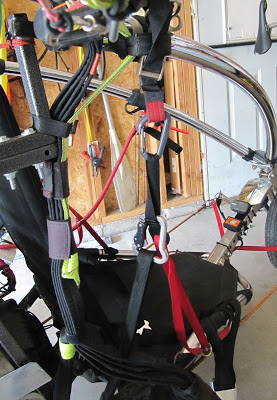
I moved the hang point rings to a horizontal position attempting to lesson the friction on the trim tab. No Joy…the problem is in the webbing that acts as a back-up in case the ring brakes loose from the bullet bar. I’ve replaced the heavy webbing with a slightly lighter and longer one which will hang loose over the risers and hopefully I’ll be able to use the trim tabs. If I end up hanging from the reserve or the H.P. ring brakes, the hangpoint will spread about two inches but I don’t think it will adversely affect how the buggy hangs or the how wing flys. The next flight will tell allot.

The wing came up crooked again but, like yesterday, it stabilized quickly. I think I’m not lining up square with the wind. I did notice that when I went from idle to full power the front wheel would dip about 6 inches and return to about 3 inches below the starting position. I expect that it will be even more pronounced when I am able to use the trimmers. I’ll move the H.P. Rings forward 3/8ths and see if It helps with the wheelbarrow effect.

The incident of the evening came as we were returning to the field. Marek’s hero camera came off it’s mount on top of the cage and went through the prop. He landed without issues in the LZ but was a long walk from the car. I knew something was wrong so I landed by the truck and walked out to meet him. We wandered around the field finding parts of the prop and eventually found the camera. Up on top is probably a good position for the camera but the vibration was working the mounting bolts loose…some lock tight would help if it does not have to be changed after every flight. I hope Marek got video all the way back to earth but I’m betting it stopped when it got whacked by the prop.

#356 Simms with Marek

I love three flight days!


I set-up on the far North end in a patch of shallow weeds. There was a nice down hill grade and even if I had to Taxi into some tall stuff, I figured that I would be moving fast enough to plow right through. Marek got off first and I was right behind him. We both went north past the dam and I chased him west into the sun.

When I was at the West end of the lake I cut the corner and approached Marek from behind getting several good shots and i caught and passed him. Then we headed over to the High Schoola and Marek played low while I played high. I did a tight spiral dive and flew through my wake. WOW! The Thumper has a much bigger footprint than the Simonini had. Marek flew through it as well and he claims that the WACK bounced him 3 inches above his seat.

#354 & #355 Chatfield

Good morning flight. I practiced with the foot steering which seems harder to hook up than is has to be. I’m hesitant to let go of the throttle and brake which is a rookie fear. I really don’t know what that is all about but I’m gong to force the issue and try to get more comfortable with the rig. On return to the field I practiced a few touch and goes and landed. After the last of the coffee I went up for a very short flight. Just because I could 🙂

Power on landings …By …Beery

First, you really need to have access to very smooth laminar winds. It’s easy here at the beach. Initially, I tell people to start learning foot drags in smooth laminar winds. This develops the fine skills to be able to maintain level flight over long stretches of ground. If you can find wind conditions of 10 mph with a beach, this is some of the most perfect conditions you can have. After you have mastered flying your unit and being able to drag your feet for a hundred yards or more (Here in Houston we can drag them for a mile or more on the beach without lifting our feet), then you are ready for the next step. Myself, just to be safe, when I say footdrag, I mean flatfooted with the sole of your shoe dragging the ground. That way, should you get just a bit too low, you can run it out and with a 10 mph wind in your face, it isn’t that hard. After you are doing well at the 10 mph winds, gradually start doing foot drags in less and less winds until you can do a foot drag in 0 mph winds. After you have mastered foot drags in 0 mph winds, you are ready to move now to powered on landings. Landing with engine running in a 10 mph wind should really be a non-issue for pilots that have developed good landing skills. If you don’t feel comfortable just doing a regular motor (idling) on landing in 10 mph winds, then you are better off not even considering a powered on landing. Now with powered on landing, I would start with the 10 mph wind condition day. As you come in doing literally another foot drag, while doing the foot drag, begin adding more and more brake/flare. As you are adding more brake/flare, to maintain flying level, you will need to add a bit more power. As you apply more brake/flare, you will need to continue adding more power. At a point while doing that foot drag, you will have basically reached a point you have added sufficient brake that your next step and input on the brake puts you at a speed of “0” and you have landed. After you have this going well, then start working in conditions with lighter and lighter winds doing foot drag approaches. As an example about 3 weeks ago, I landed at the beach in about 1-2 mph winds. It was going to be a bit fast. I approached into the wind, started my foot drag, and started flaring but adding power. After 75′ of dragging my feet, I had then slowed things down to the point I walked off very nicely in 2 or 3 steps the remaining speed. Another point to make here is that while doing your foot drags and powered on landing approaches, drag with one foot, but keep the other foot out in front of you ready to take a step. Don’t drag two feet as it puts you in a poorer position to recover if you suddenly need to run something out. Myself, I think being able to fly inches off the ground or dragging feet for extended periods of distance is a skill that everyone should try and master. What it does is develop the hand/eye/wing/throttle coordination to respond tithe most minor of air disturbances and leads to a pilot that can actively fly. There are a lot of times I fly with other pilots and they complain about it being bumpy and it isn’t to me as they aren’t actively flying their wing. The finer your control of the wing, the more you can dampen out the bumps and oscillations and the more enjoyable the flight. That’s my 2 cents. Beery
#352 & #353 Chatfield …Power on Landings

God made Days off for days like today!

The season is changing and it’s happening all too fast. Now days, when I get to the field at 6:00am, it’s O’Dark Thirty. Plenty of time to finish that Rock Star and let the caffeine get into the blood stream. It had been partly clouding all night and this morning was hazy and 55 degrees
The wind was SSW variable 4 to 7 which meant I had a slight uphill grade and rotor from the “Club House”. The wing came up fast and the buggy had stopped rolling after the first two feet, I was able to add a little “foot power”, but the wing stalled and fell to the left, by now, I was starting to roll, so I added right brake and watched the wing swing to the right until the tip was about 6 feet above the ground. Now some left brake and this time it centered and was rock solid over head. Small wing Heavy trike… The Eden III is easy to muscle around because it’s smaller, lighter material and more responsive than the Power Play. I don’t think this would have tipped the Trike Buggy Basic but I’m sure that I would have felt the trike start to lift on one side. Because of the extended wheelbase and low and heavy CG, the Thumper is incredibly forgiving. When the wing was about 40 percent loaded the “side pull “was just discernible.

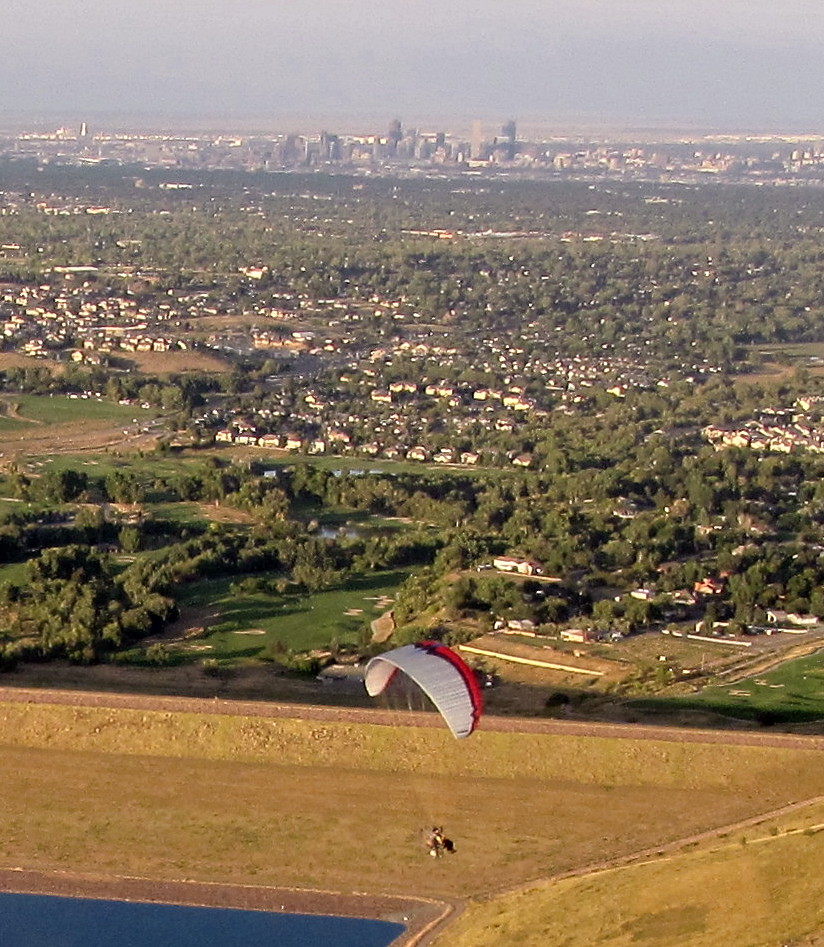
When the wing is oscillating like that it’s a good time to be looking up at the glider. 🙂 The mirror is great for some pilots, but it tends to take up too much of my attention and I lose the big picture. The climb out was slow, which was made worse because the surface was sloping upward. Once up, it was mostly smooth air. The winds were flowing in a circle, clockwise around the area. I could fly downwind along the western edge of the park and still be downwind on the east side of the park coming home. The neat thing was that the area around the Balloon Port was calm, because it is inside the circle. I watched two balloons go up and hang right over the Port, they didn’t move 20 feet except vertically the whole time they were in the air.

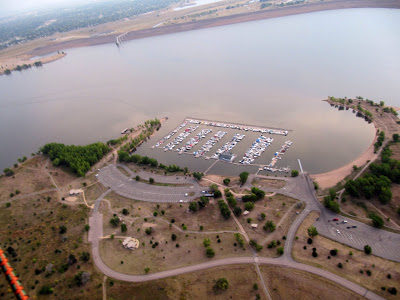
I took some shots of the Marina, landed power on and practiced the low and slow. Then took a brake and did it again. The overcast had damped any thermal activity…I could have flown for two more hours it was that good!

Chad…Please bring some different length hang straps and help me dial in these wings for the Thumper Bullet.
1. Measure the current straps and Riser position in relationship to the hang point rings

I saw God Today #350 & #351 Chatfield

Lucky guy

Intermediate syndrome is an affliction that usually affects a pilot after 40 or 50 flights, or whenever they first start to feel good about their abilities.

It’s characterized by over confidence in both man and machine and it usually leads to a blunder that endangers life. It could present itself in any number of ways… an error in judgement, or a bad reaction to Mother Nature. It might be technique or a mechanical issue. Whatever the cause, if the pilot survives the incident…he should think real hard about either quitting or redoubling his efforts to improve.

It might be time to go to a maneuvers clinic or have some quality radio time with a good coach. It’s absolutely a good day to go over the machine and wing with a fine tooth comb.

Optimistically, there is an epiphany that stays with the pilot for the rest of their career, because on that day… the bag of luck is now half empty and the bag of experience is not yet full.

When I realized that my life was being supported by a glorified key

chain and some thin 1/2 inch webbing…

I thanked the Creator that I was still alive.

Then I looked for the best way,

to proceed to earth…

as directly as possible.

I’m still shaking my head trying to figure out how it happened.I attached the riser on the left side to the cheap plastic beaner that I use for the foot steering instead of connecting to the heavy stainless beaner that ties the wing to the buggy. I didn’t realize my mistake until I noticed that the foot steering cable was pressing against my left side. When I saw that the rig was being supported by a glorified key chain and thin 1/2 inch webbing…I couldn’t believe that I was still alive. Not only was the beaner unrated and not designed to carry a load, the loop it was attached to was loaded against the stitching. There were two places where a failure was imminent. Looking at the materials it should have failed when I loaded the wing before take-off …and… I wish it had. It would have been more dramatic and made a bigger impression but it wouldn’t have killed me. As it was a non-incident, I hope that the magnitude of the error sticks with me.

I had to get down …right now! I was 400 feet AGL and about the correct distance to glide back to the field, so I did a slow flat turn toward the field and landed without incident.

What were the causes that lead to this huge goof ?

1. I had switched to the Eden III which does not require the extra loop of webbing to get the hangpoint right. When it is configured this way the hangpoint loops are not long enough to reach the normal keeper on the bullet bars. So…I end up attaching the beaner to a loop on the foot steering for transport.

2. I must not have had enough coffee because it is almost impossible to imagine an alert mind attaching a plastic carabiner to the riser. It is so much more difficult to thread the correct carabiner that it should have set off alarms when that slim plastic beaner tip slipped through the loop so easily. The length was about right and when I pulled on the riser to take out any slack, it pulled the hangpoint loop just as if it were correctly attached.

I thought perhaps I should move the foot steering forward on the bullet bars to get them away from the hang point straps, but I don’t think I’ll do that. Having the webbing behind my shoulders is cleaner and I doubt I’ll ever look at the foot steering again without remembering the day I hung from a cheap 2 inch plastic carabiner.

This is the first real stupid mistake I’ve made in PPG and certainly the first one that endangered my life! I was deeply affected by the experience, and it was heavy on my mind for several days. I will strive to learn from this and be a more responsible pilot.

I vote for better pilot.

#348 & #349 Chatfield

This was an evening that just didn’t gel.

Conditions were good, light winds warm temp. It looked to be a perfect evening but I wasn’t comfortable in the air. My first launch looked like hell. As soon as I left the earth, the wing ( 28m Eden III ), was pulled hard to the left and then to the right. As I gained altitude it got bumpier and after a few laps around the field I landed. The second flight was a repeat of the first. I got the impression that no matter where I went …it was going to be turbulent.
Greg and Marek on the other hand stayed below 100 feet and they found the air to be just fine. I watched Greg yank and bank, practice swoops and dives and I just couldn’t figure why I found it to be so ratty.
The gradient had me beat.

Pre-Flight

Changed wire on Tach with smaller ga. It seems to be reading much faster and more accurately

Question for Terry
Motor is mounted to the frame with two bolts. There are two other spaces available, is this as you want it?.

IVO Prop is “flexing” about 1 1/2″ at Idle. Chad has used a GSC (?) adjustable and likes it.
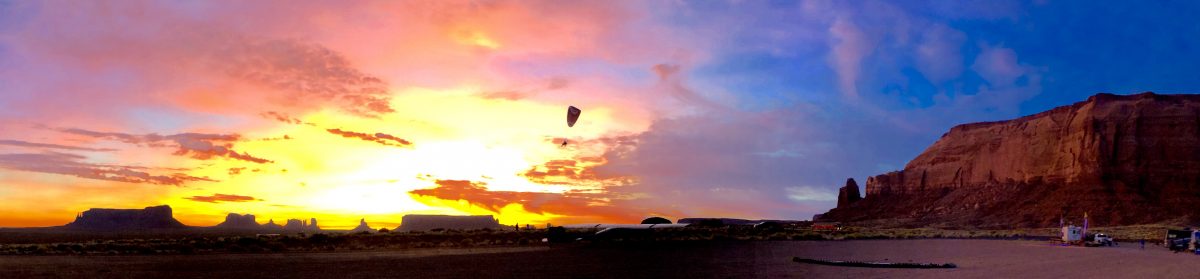
Terry is looking into the Warp Drive Prop. Maybe at MV I’ll get the chance to try a different prop.

Tightened up the Reserve Harness. it was getting sloppy.