You start with a full bag of luck and an empty bag of experience. The trick is to fill the bag of experience before you empty the bag of luck.
I was sitting at the kitchen table having a cup of coffee and enjoying our view of the Rockies when I saw what I thought was a skydiver. He was swinging in big arcs and I wondered why wasn’t he descending. It was too far away to make out more than the vague shape of the canopy, it looked like a parachute…but… Why wasn’t it descending? How was that guy staying up? My kids and I watched for several minutes until we couldn’t see him any more.
A week later I found out…
I was sailing at Chatfield Reservoir, it was an hour before sunset and light air had slowed the race to an “inches per minute” crawl. I sat at the stern, minding the tiller and watching for any sign of breeze to could exploit.

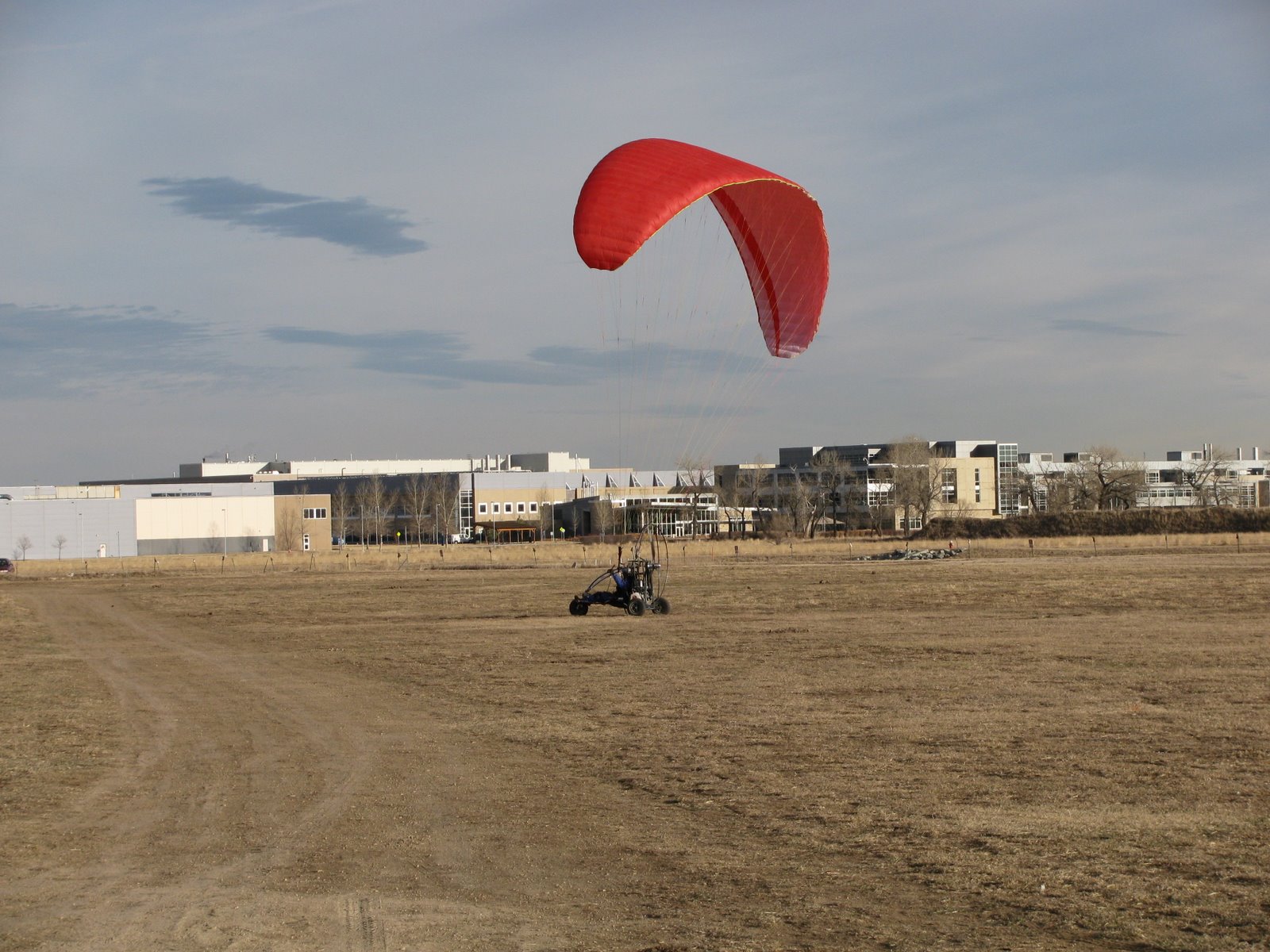
The flashing of a strobe caught my eye and I saw a strange looking contraption fly over the top of the dam. As it got closer, I could see the pilot, was sitting in a small three wheeled vehicle about the size of a go cart. The cart was suspended from an elliptic canopy marked with a zigzag design. I pointed him out to the rest of the crew as he descended and flew along the swim beach. It was amazing how slowly he could fly, gliding over the sand, maybe 50 feet up. The motor sounded like a small motorcycle but the prop gave it that special timbre that says aircraft.
That night after the regatta, I went to the Internet, and discovered what I was looking for is called Powered Paragliding. There were a variety of sites and newsgroups dedicated to the sport. The local group was called the PPG Flock and the national group is, “The Big List. There was even a weekly Internet Talk Show where experienced pilots gave advice and told hanger stories. All of the previous shows were available in the archives so I listened to a couple of segments. They sounded like a great bunch of guys who had been involved from the beginning and were immersed amazing new sport. The PPG podcast turned out to be a wonderful resource for a wanna-be pilot and I listened to probably fifty hours of PPG Radio over the next several months. There was plenty of information available, all I had to do was sort through and try to absorb the best. At the end of my first night of research I came away knowing.
PPG’s are the most personal form of flight. They are able to take off from a small field and stay aloft for up to three hours. Having evolved from free flight paragliding it uses the same wing but it has become a very different sport with a whole new set of rules. Unlike free flight, the pilot has the ability to overcome gravity using the thrust of a lightweight two-stroke motor driving a 40 to 50 inch propeller. Most of the flying is done between 800 and 2000 feet but it is possible to fly to 18,000ft and even higher. Best of all, I discovered there are no licenses or certifications required. By the grace of the Federal Aviation Administration’s publication, (FAR 103), PPG pilots are allowed to fly freely, provided they honor restricted airspace and other people’s rights. The object is not the destination so much as it is the art of getting there. The more I researched, the more it resonated with me.
I had participated in potentially extreem sports most of my life , rodeo, sailing scuba, cycling and kayacking ….all good outdoor activities that can get hairy on occasion. Powered paragliding was atractive to me on several levels and it takes place in a medium I’ve yet to experience…The air. Water and air are subject to the same laws of Fluid-dynamics and I was good with water so I thought I might have a clue.
Currents in the atmosphere behave similarly to currents in the ocean or the flow of water in a river. I imagined the hydraulic forces of water in a boulder-strewn river, the water flows around and over the rocks, the same way, air flows over and around buildings, trees even mountains. In both cases the person navigating these currents has to read the terrain to be able to avoid danger. The unsuspecting paraglider can be slammed to ground if caught in the swirling rotor on the lee side of a building just like a kayaker is flipped upside-down in the turbulent currents below a large boulder. The similarities between sailing and flying are striking and numerous; both exploit natural dynamic forces to create lift and forward momentum, the glider works like the sail of a keelboat, and the pilot and motor act like the keel working against the force of air on sail. The combined use of thrust and brakes changes the angle of attack and wing shape the same was the rudder and sail trim work on a sailboat.
Yeah it looks like magic but I could understand how it worked and figured it was something I could do.
There weren’t any schools nearby but I did find one listed in Loveland, called Adventures in Powered Paragliding. I spoke with the instructor, Brian Smith, and made an appointment to meet in Loveland the following Friday at dawn. As fate would have it, I missed the highway exit and was late getting out to the field but as I arrived, there was a guy making an approach for landing. It was beautiful! Like Gabriel the Archangel, he did a quick ninety-degree turn, lost a bunch of altitude, straightened out and touched down. No muss no fuss, just fly and land. Then another guy took-off and flew around the field for about ten minutes and landed right next to the truck. I stood around like a 12-year-old kid with some old-fashioned barnstormers. While the pilots engaged in small talk and packed up, I poked around and inspected their equipment. I was in awe of these fellows, who carried an airplane around on their backs. The whole experience seemed larger than life, but there was no question in my mind that I could do this. It looked so easy; all you had to do was run into the sky. How come it took me so long to discover and why wasn’t everybody doing it? I saw myself flying to work and just about anywhere else I wanted to go. This was the future!

So, I introduced myself to the instructor, Brian Smith, who can only be described as, “all country”. He packed a chew, cut his hair way short and was built like he had been bucking hay. I’d known a lot of guys like him over the years and liked him right away. He quickly put me at ease, showing me around, explaining the equipment and describing the training process. Ten minutes later, I was writing a check for the whole sha-bang; wing, motor and training. I was going to fly… Brian gave me a syllabus, from the Adventure Paramotor Company and had me sign a liability waiver. My career in aviation had begun.
A couple of days later I was at Brian’s field to learn ground handling. Brian had just received a new wing so he lent me his old one for practice. The field where we were working was a horse pasture with lots of holes, high weeds and in one place there was a plywood sheet bridging an irrigation ditch.
The first thing we did was go over the equipment. Brian explained the risers, which were my connection to the wing. He showed me how I would use the “A” risers to help the wing inflate and where the B, C, & D risers attached and how their position affected the wing. He then showed me the brakes and explained how the brake lines were measured and knotted to the toggles.
Next he laid out the wing and put me into a training harness. It must have been a universal size, because when I was finally all cinched up, the left over strap material was dragging on the ground. I got the excess webbing out of the way by tying it around my waist and proceeded to learn how to hook into the wing and hold the risers for a forward launch.
There wasn’t enough wind to kite the wing so we spent the morning practicing forward launch techniques. I would lay out the wing; clear the lines, and hook in to the wing. Then, I would put the A riser d-rings between my thumb and forefinger and drape the rest of the risers over my arms. Brian would then position me so that I would be able to start my and run and take a few steps while the lines were still slack. The idea being that my inertia would pop the wing up quickly. I’d take one last look to see all the lines were clear and that the risers were correct, then, look at the windsock to make sure my heading was right, raise my arms to the ten and two o’clock position and start my take-off run.
Sometimes inflation would be perfect and the wing would come up straight and fly overhead, while I stumbled as fast as I could through the weeds. I was surprised by how much resistance the wing created, both during the initial inflation and even, (but to a lesser extent), when fully up and overhead. All the forward momentum I’d built up in a couple of steps was gone as soon as the lines became taunt. So I would pull and claw for 4 or 5 steps until the glider was flying. Once the wing was fully up, I could run a little better but the aerodynamic resistance from above and slightly behind prevented me from exceeding anything faster than a trot. On grass it would have been smoother but I don’t think it would have been any faster.
Occasionally the glider would come up crooked and when that happened; I would try to get back under the center of the wing to equalize the load and get it flying straight overhead. The main thing is to keep moving forward. It would have helped if I’d had some experience with broken field running, but the more I practiced the easer it got. Later when a light breeze came up I learned that if I wasn’t dead into the wind and putting equal pressure on the “A’s” the wing was guaranteed to come up crooked with one side higher than the other. Another challenge was trying to make longer and smoother strides. I was having trouble because my choppy running style was causing the wing to bounce which disturbed the airflow over the top of the wing. I knew that later when I was “doing it for real”, the smoother my run, the quicker I would reach take off speed. When I had enough Brian and I took a break. We watched several PPG videos including Parastars, Paratoys and Risk and Reward which is an excellent video for new pilots, it features William Shatner and covers a wide range of topics every pilots must understand. We talked about risk management and some of the dos and don’ts and eventually got around to equipment. My selections were limited because of my height and weight, there some 100cc motors which would put out adequate thrust but only a few companies were making frames that would be small enough for me to carry. On Brian’s recommendation, I selected a “SuziCruiser” frame made by Skycruiser with MacPara 24meter Eden III wing powered by a Snap 100 motor made by Cisco in Italy.
That evening I thumbed through the syllabus. It was originally written in French and the English translation was difficult and sometimes comic, but it was all I had. So… I dived in and tried to figure out all the graphs, tables and drawings that I mostly didn’t understand. Terms like longitudinal pitch and sink rate were a little intimidating but others like chord and angle of attack were familiar from sailing and their recognition gave me a bit of confidence. Full of enthusiasm, I became a sponge and spent many nights watching PPG videos, listening to PPG Radio and reading incident reports on the USPPA website.
Two weeks later Brian called and said, “Your equipment is here”, and so, I cleared my schedule and was out there the next morning. We assembled the motor and hoisted it up, using his garage door frame to support the weight. Brian’s “simulator” wasn’t sophisticated; a set of toggles and a BMX brake lever were my controls, the garage held me up and his little boy made motor noises. We practiced getting into the harness, getting out of the harness and other moves I would need while in flight. Then it was back out to the field to practice with the motor. I put the motor on my back and tried a forward. The equipment overwhelmed me. Getting into the harness was harder than I thought it should be and then dealing with the risers and a throttle… How was I going to be able to keep everything straight at once?
I was very concerned that I didn’t have enough strength to run with the weight of the motor on my back. It weighs right at 50 pounds, but it felt like 100. I could do one or two forwards, but then, had to sit and take a break. A couple of times I was able to launch the wing and run but for the most part I would blow it as soon as the wing started to resist my forward movement. I was also having trouble with my left knee. Sometimes while running it would pop out and I would either fall or drop to a crouch with the wing falling on top of me. Brian assured me that when I did a forward with the motor running it would be much easier. He explained how the thrust would help push me forward and that as I built up speed, the wing would lift the weight off my shoulders. I later learned how to adjust the harness to make the motor ride higher and closer to my back but those first several weeks were agony. I was beginning to have real doubts about my strength. At home, I was walking around the house and running on the treadmill with a weighted backpack. I was also doing some weight training and anything else I could think of to help me run with the motor.
Over the next ten weeks I alternated between driving up to Brian’s place or kiting in local fields and parks. Along the way I met some of Brian’s other students. The guy most often at the field with me was Doug, Brian’s business partner. Doug had decided to fly a trike, early in the game, due to an old knee injury. I also had knee issues and he advised me to pick-up a knee brace to prevent further damage.
I also trained with Roshana. She was a petite gal who had been driving out from Kansas on a regular basis. I was impressed that she would take a chance on good weather and drive 5 hours to get in a couple of days of instruction. I also took heart that someone lighter than I was deemed, strong enough to hoist a motor and fly. Her kiting skills were impressive; instead of using a training harness she would hold the risers and fly the wing by moving the top and bottom of the risers in opposite directions. One evening I watched her practice forwards with her motor on. Because she was light, Brian and Doug ran alongside with one hand on the harness to provide additional thrust. It was obvious that the weight of the motor was holding her back but with two strong guys pulling, the wing was lifting most of the weight and they were able to get some impressive ground speed. It was encouraging because she was definitely ready to go to the next level and I was sure that if she could get the wing inflated the motor would take care of the rest.

I also met a professional solder named Dave who was hoping to get the basics of powered paragliding down before being rotated back to Iraq. I only trained with Dave once, it was memorable because it was his first flight. Looking back it was a little spooky but I didn’t know it at the time. Brian’s field wasn’t very big and there were a few obstructions to contend with once he was in the air. On the day for Dave’s first flight, conditions looked perfect. There was just enough breeze to help with takeoff and all of us looked forward to a great first flight.
As soon as Dave left the ground he started to turn directly toward a barn and a group of trees. Brian coached him to use a little left brake to stay clear of the barn but he continued to head straight for it. I was blissfully ignorant but Brian let out an audible breath of relief when he cleared the barn by 20 feet and the trees by ten. You could tell the barn was creating some turbulence by the way the wing was moving, side to side and back and forth. Dave dropped a few feet and then started climbing. Brian must not have liked what he saw because he directed the pilot to come in and land almost immediately. Apparently the radio had failed because he flew downwind a couple of hundred yards, turned and started to fly big circles over the field. Brian tried several times to reach Dave with the radio but something must have come loose because he never did show any signs of hearing us. Eventually Brian gave up on the radio and made hand signals for him to come down. After about 30 minutes with Brian waving and trying to get Dave’s attention, he finally turned into the breeze and started to descend toward us. He was coming in a little short and I was afraid he was going to fly right into a wire fence, but at the last second he raised his legs, cleared the wire and slid in on his butt. It wasn’t pretty, but no harm was done to man or machine. I celebrated by slapping Dave’s back and congratulating him on his first flight. Dave was completely unfazed and ready to go again.
I searched far and wide for good places to practice. Anytime I could duck out of work, no wind or too much wind, I was out there, practicing my kiting. Suburban parks looked great but I soon learned that the trees around most parks create rotors that would collapse the wing without warning. Even thought it was easy to run on well maintained grass, I needed wide open spaces to get clear air. One time, I tried some ground handling at the top of Ruby Hill which is a large park with a great hill overlooking Denver. I think the sight of the city stretching out below attracted me and I can’t say for sure, but was probably considering of the possibility of doing a sled ride / flight down Ruby Hill. Common sense prevailed though, because the first time I kited the wing, the upslope lift spooked me and I never went back.
My first experience in the air was at the Aurora Air Park, east of Denver. After kiting awhile Brian decided I was ready for my first tow. He clipped me to a length of nylon line and I’ve never seen this done before or since, but… Brian pulled me into the air, with him acting as the winch and me running a forward launch. I probably wasn’t more then 10 or 15 feet up but it felt high and watching Brian below pulling on the tow line made me feel even higher. The whole experience probably only lasted forty five seconds but after a lot of time on the ground I’d finally got a taste of flight and it was sweet.
When the wind was over 3 or 4 knots I would inflate the wing using what is called the reverse launch. You lay out the wing in the same way as a forward but face the wing and step backwards to start the inflation. Once the leading edge is a couple of feet up, the wind finishes the job. Then, when it is overhead and stable you turn toward the direction of the breeze and start the take off run. I was having a terrible time routing my brakes so that when I turned, the brake was on the outside of the risers and free of tangles. Sometimes it worked and other times I would get the wing up and have to flail with one hand to free the brake line, which had threaded through or around the risers. Adding the throttle to one hand just seemed to complicate the problem. I couldn’t consistently do it and was doubly frustrated when Brian could take one look and have it set up for me in a second. It was months before I could set up for a reverse with confidence.
In late October we met at the Aurora Air Park
Brian strapped on my motor and checked the conditions. There was a light but steady breeze from the east. Brian was grinning from ear to ear and claimed that it was, “smooth as butter”. Now it was my turn so I strapped in and set-up for a reverse. The wing came up nicely but when I squeezed the throttle to add thrust the motor bogged and died. I’ll never forget standing there, with a perfectly stable wing overhead, watching the moon rise while Brian pulled several times on the starter cord. When the wing collapsed I unhooked and started it back up, it died as soon as I tried to run it up.
Two-stroke motors were unknown territory and my little Snap 100 had its share of peculiarities to be discovered. The way it would bog down during rapid acceleration was probably the biggest hassle and it wasn’t until much later that I finally learned how to tune the carburetor so that I could hammer the throttle when I needed it. That October the problem was still a mystery, the motor died when I needed it most, and all we could say was, “Well…it is what it is”. That evening I coined a new term while updating my training log, NFD, it is short for, No Fly Day and it might be used because of bad weather or equipment failure or attitude or just because I just couldn’t get into the air. That memorable evening was the first, but not the last…
“NO FLY DAY”.
My second attempt wasn’t any better; Brian and I were at the Airpark at dawn. We launched a pilot balloon and saw that there was a light but steady ground wind which increased to about 10 or 15 mph at 300 feet. It was marginal, but flyable. The take off would have me running down a slight grade which made me happy. I set up for a forward and took off running. The wing came up straight and I could tell it was bouncing with each step but I could also tell it was getting faster and the motor was getting lighter. Then I pulled the classic newbie blunder, just as the weight of the motor was gone and I started being lifted I allowed myself to be scooped into the harness. Instead of running into the sky, I jumped into my seat. For a couple of seconds I was flying but almost immediately started to drift back down. I was moving forward at a pretty good clip and it looked like if I touched down I would do a long slide… face forward, so I lifted my legs. It delayed the inevitable but only for a couple of seconds and then, I came down on my seat. I heard the prop cutting through the high weeds just before it struck the earth and shattered. I had been so close I could taste it. My hopes for the day were dashed but I knew that as soon as I got a new prop it was going to happen. Leon Wacker at Paracruiser was great about rushing me a replacement but the way I was feeling, even “Next Day” wouldn’t have been fast enough.




 Powered Paragliding. A most Personal form of Flight

You must be logged in to post a comment.