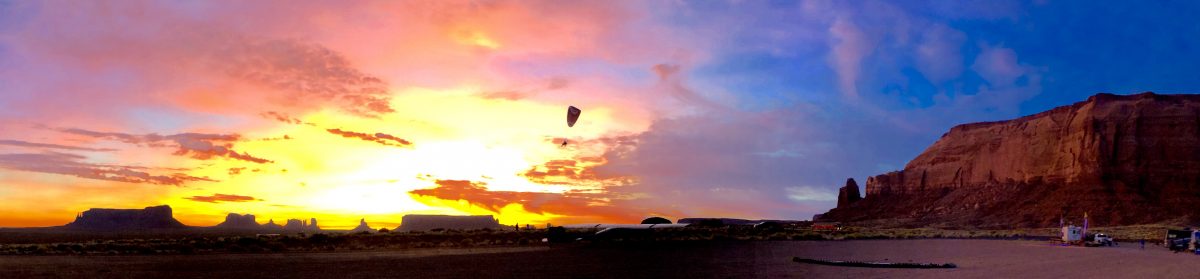
Chip Marek and I. Also a very strange little dude who had followed me from the gas station. Not the best of days, Marek and Chip were planning a long flight and I had only enough gas for about 45 minutes.
Marek got up quickly and I went north to the golf course and then to the Park. When I got down Chip was standing by his machine which was badly damaged. he explained that he had put it on his bumper rack to check out a problem and forgot to bolt it down properly before testing the machine. It jumped out of the rack and broke the prop…cage…and muffler. $1000 + in damages.
Category: Incident
88 89 90 Chatfield
Light and variable winds. Chip was also there. I did the pre-flight twice because I felt like I was missing something. Halfway through the taxi I found it…my Leukemia Cup has was on my head instead of the helmet. I located the cap after the 3rd flight in tiny little pieces. I hope this is the last time I lose a trusted hat this way.
#71
Motor Out!
Take off was a normal early morning launch. I was heading to the Balloon Port and approaching the crook of Chatfield Res when the engine died. I tried several times to restart but gave up and landed in a field of tall grass. It must have been 5 feet high and almost caused a hard landing because I didn’t realize how tall it really was and flared a bit early. I hitched a ride to the port and Alex gave me a shuttle out to the truck. When I got back to the park Bubba quickly diagnosed the problem as a broken wire which we repaired immediately.
21st thru 33rd
9/4/06 #21
The morningof the wet wing… Strange takeoff “Lift no Lift” run out.
9/06/06 #22 Great Flight …Saw one man personal Balloon by the Swim beach… going farther afield
9/12/06 Incident with equipment damage
The whole fam damily showed up to watch a flight and I blew it when I got a wrap around the left hand and fell on takeoff. The wing came up good but started to turn during the run. I popped up briefly but came down immediately on my left side, breaking equipment and injuring my knee and wrist.
#23 9/25/06 Most Excellent Flight!
Got video of the whole thing…Including John Sieb’s exploding “cheap Mexican” propeller.
this was a milestone flight. My first long flight in Denver with another pilot. The DVD is the best video yet.
#24 9/28/06 Lots of People some didn’t fly. Sunset with layers of cold air mixing and causing bumps
#25 10/06/06 Short lap and landing after noticing a half twist in the risers
#26 10/13/06 Flew till out of gas . Pulled lots of break with no power and experienced quick turn and rapid decent Poor landing
#27 10/23/06 Clint Murphy was observing from home field…great to see him
Tweaked knee on run out
#28 11/03/06 Short flight Perfect takeoff and landing..Some virga scared me down…using knee brace all the time. video of landing is good and later ended up on my Ipod.
#29 11/8/06 Good flight …Broke exhaust bracket…exhaust was clipping prop.
#30 11/19/06 So So flight butt landing
#31 11/22/06 High winds Experienced extreme crabbing of the wing..Good reverse good landing
#32 11/25/06 Good long flight
#33 11/26/06 2nd Annual Birthday flight
Death of Barton George
No Fly Day 12/08/06 Rookie mistake… Jumped into sky …Broke prop and bent Frame…This was the end of my first season. It would be a long time till I flew again.
Barton George is Killed in Mid Air Collision
Report on Barton’s Incident
From Bubba:
No one will ever really know exactly what happened the day Barton died. There will be a report posted on the USPPA site. But, here, after much discussion by those of us that were there, think happened.It took two simultaneous mistakes for this accident to happen. Both pilots were in the pattern. One pilot was trying to adjust his radio to find the right channel for the clinic instructor. Someone had given him the wrong channel to monitor. The other pilot simply turned onto his base leg without clearing first. If either pilot had been alert, this tragedy never would have happened. The higher pilot looked up from his radio equipment to late and found the other’s wing in his lap. He pushed the wing off his lap and then pushed the remaining lines off, hoping that the lower pilot’s wing would re-inflate as it fell. There was enough altitude for this to happen. Unfortunately, when the lower pilot fell free, he fell backward into his wing. As he did, he pulled full throttle and ate his wing and fell to his death. The other pilot, fortunately, recovered and landed.In the 14 years that this sport had been in North America, only one other major mid-air collision has been reported and both pilots survived with minor injuries. That’s a pretty good record when you compare hang gliding, free flight paragliding and other ultralight sports. PPG is still the safest way to take to the air. So safe, in fact, that it appears we may have become complacent.This should be a serious wake up call for all of us. First, always be aware of the air space around you. Above, below and to both sides. If you need to remove your hands from the toggles to perform some task, first check the air space. You may need to fly away to a clear area first. Never do this in the pattern. Second, always clear the air in the direction you intend to turn before you do.
USPPA Incident Report
General Information:
Fatal Midair Collision
Date: 10/09/2006Time: 0800
Location: Albuquerque, NMPilot
Age: 40
Gender: Male
Pilot weight (without motor): 150 US Pounds
Rating: None Experience: Less Than 10 Hours Solo
Incident: Collision with Other Aircraft/Ultralight Primary
Cause: Pilot Error
Inflight Contributing Distractions: Radio Transmission
Windspeed: Light (Less than 5 MPH)
Wind Type: Variable Thermal Conditions: Light (Less than 300 FPM)
Visibility: 6+
Surface: Dirt or Small Rocks
Terrain: Flat Site Elevation: 5300 (feet above sea level)Phase of Flight: Cruise Purpose of Safety Gear Used: Helmet
Communications: Two-way Radio w/ Helmet Mike & PTT
Damage to Pilot’s Equipment: Severe (Greater than 20% of New Price) Wing: DHV 1Motor: n/r
Injury InformationPilot: Fatal
Narrative: While flying a morning session of practice and general familiarity, a collision occured between two powered paraglider pilots. Pilot Y was flying a yellow wing in an east direction, climbing slowly and in a shallow turn to the right. Pilot B was flying a blue wing in an east-southeast direction, straight and level. Pilot Y was to the North (left of) pilot B and they converged on a generally southeast course. They were about a half-mile from the field, east of the pattern in use, and heading away from the field. Pilot B says that he looked around then looked down to change radio frequencies and when he looked back up he was upon the yellow wing which was turning towards him. The middle of the yellow wing hit his feet and tangled in pilot B’s body/motor. The yellow wing hung up, slowing him down and causing the blue wing to surge forward. Pilot B emerged headed down steeply, pulled the brakes hard to recover from the dive at about 50 feet. The force pulled Pilot Y’s wing sideways forces which likely whipped pilot Y upward and sideways, causing him to fall into his wing. He hit the ground from this condition, wrapped up in the wing. Pilot B landed immediately, essentially unhurt. Others arrived soon after to administer CPR but Pilot Y could not be revived.
No one will ever really know exactly what happened the day Barton died. There will be a report posted on the USPPA site. But, here, after much discussion by those of us that were there, think happened.It took two simultaneous mistakes for this accident to happen. Both pilots were in the pattern. One pilot was trying to adjust his radio to find the right channel for the clinic instructor. Someone had given him the wrong channel to monitor. The other pilot simply turned onto his base leg without clearing first. If either pilot had been alert, this tragedy never would have happened. The lower pilot looked up too late and found the other’s wing in his lap. He pushed the wing off his lap and then pushed the remaining lines off, hoping that the lower pilot’s wing would re-inflate as it fell. There was enough altitude for this to happen. Unfortunately, when the lower pilot fell free, he fell backward into his wing. As he did, he pulled full throttle and ate his wing and fell to his death. The other pilot, fortunately, recovered and landed.In the 14 years that this sport had been in North America, only one other major mid-air collision has been reported and both pilots survived with minor injuries. That’s a pretty good record when you compare hang gliding, free flight paragliding and other ultralight sports. PPG is still the safest way to take to the air. So safe, in fact, that it appears we may have become complacent.This should be a serious wake up call for all of us. First, always be aware of the air space around you. Above, below and to both sides. If you need to remove your hands from the toggles to perform some task, first check the air space. You may need to fly away to a clear area first. Never do this in the pattern. Second, always clear the air in the direction you intend to turn before you do.
8th & 9th At the Sea

8th & 9th Flights
2/12/06
2/12/06
It was a perfect launch and a perfect landing! This was the best flight so far! And I think it was because of an equipment breakthrough. After the last flight I adjusted the harness so that the motor rode higher and closer. The shoulder straps are now a lot tighter and the sternum strap is looser. The new set-up allows me to run in a more upright position which made the launch a lot easer! Once in the air I felt a bit constricted but I could certainly loosen it or live with it. The important thing was I was running more upright which used the thrust better and allowed me to glance at the wing to make sure it was flying straight.
I flew north along the coastline at 1600 feet, until I was over the “rebel” camp of Mo Shelton and his entourage. After awhile I was feeling so good that I took a wild ass chance and used my mirror to check fuel level and I even took a few pictures. Then I climbed to 2800 feet and tried some ¾ power turns. What a rush! It didn’t take much brake to get into a mild bank, and for the first time I felt an increase in gravity. I doubt it was more than half a g but it got my attention…and I liked it!
Number nine was just a quick victory lap. I should have stayed up longer but I was worried that I would run out of gas and I didn’t want to do a dead stick landing. I climbed out, flew over the dome then turned left and followed the beach for about a mile then turned left again and headed back. I kept the power up and climbed all the way back to the LZ and was at 2500 feet when the LZ was right below me. I let the motor have just enough power to engage the clutch and keep the propeller spinning, then I did “S” turns and 360’s for a long time while I descended. This time I made sure to have my legs in position and did a neat little two step landing. I was a great way to end the last flight of my first Fly-in.
It was absolutely beautiful when we left. The air was dead still and the sun had just set. The last bit of twilight was painting the mountains purple, and there was a full moon reflecting off the sea. I marveled at how different the place had become in just a few hours. Where before, there had been the cacophony of dozens of paramotors, now you could hear the occasional sea bird. The crowd was gone and with it went all the furious energy that had driven the event. Everybody was moving slower, strolling instead of trotting. In the air was the silhouette of one last pilot who had gone up for a final flight. I listened to his motor wrap-up as he climbed out over the sea and then drop in pitch when he would glide back toward shore, then power up and out to sea again. I enjoyed his solitary flight for ½ hour. He was really quite good, doing all kinds of maneuvers, which would not have been tolerated when the sky was crowded.
He did wingovers and spirals and a move I had never seen before. The pilot would thrust forward and at the peak of the swing kill the power causing the wing to surge forward and dive. I kept expecting to see the leading edge of the wing collapse but he displayed fine control knowing just when to add a little brake and he consistently pulled out of the dive cleanly with a minimum of pendulum effect. He was still playing in the moonlight when Doug came by to pick me up.
Learn from the mistakes of others.
You won’t live long enough to make all of them yourself.
The Paratoys Fly-In had been great. I doubled my flights, saw lots of different equipment, and even witnessed some honest to god incidents. The first was Doug who tried to take off in terrain that was too rough and obstructed for a trike. It was amazing how fast the trike swung around when he got caught by a small pinion tree. And there were a couple of other trike incidents, one was a guy who rolled his trike when he insisted on taking off with his wing oscillating forty-five degrees. Fortunently there were no injuries and it was certainly a well-built trike because he was able to crawl out from under, reset the wing and launch. Another trike incident was a guy who was taxiing off the field with his wing bunched up with him in the trike, a loose line got caught in the prop and sucked the wing right out of his lap. He broke the prop and parablended his wing.
I also saw a couple of classic mistakes that led to injuries. One was a fellow who didn’t check his carburetor during preflight. When he started it the motor ran up to full power and got out of control. He received a couple of pretty serious lacerations on his arm and leg. The worst injury of the weekend was a fellow who had been flying for a several years but had not often. He took off and apparently didn’t think he was climbing out fast enough. He pulled some brake to increase the climb and for some reason kept pulling brake with full thrust until the wing stalled and he dropped out of the sky from ____ft. up. Both legs were broken and I learned later that he required several surgeries and pins to rebuild his legs. The most dramatic incident I witnessed was a new pilot’s first flight. It was the last day, late in the afternoon and the guy had been training all weekend. His instructor gave him the go-ahead so he could solo before it was all over. I didn’t see the whole flight, but what happened was, he overflew the landing zone and crashed into the cab of a pickup. Just like Dave had done a couple of months earlier he lifted his legs and stuck them straight out in front just before impact. The bottom of the frame hit the cab just above the window and crumpled. Then the pilot slid across the roof and impacted the ground about 10 feet past the truck. Lots of damage to the equipment with only the motor and wing salvageable but luckily the pilot was not hurt. He sat there for quite some time and was obviously shook up but in the end …he walked away.
 Powered Paragliding. A most Personal form of Flight
You must be logged in to post a comment.